Children’s tricycle
The Museum of InnocenceThe Children’s tricycle is the object Kemal Basmacı brings to Füsun’s family home on May 19, 1976, ostensibly to return it to Nesibe. It gives him a reason to make the visit he has long anticipated, but its childhood associations cannot restore the intimacy he hopes to reclaim: at the dinner, the tricycle connects Füsun and her husband Feridun to a past that Kemal did not share with them as an adult.
Identity and Earlier History
The tricycle belongs to the childhood world surrounding Füsun and her family. Kemal’s letter tells Füsun that he wants to bring it back along with the earrings he has recovered from a box belonging to his father. He imagines that the return will lead into the evening meal with her parents that they had planned long before. In his account, the tricycle is not simply a practical item to be delivered; its return provides a socially acceptable purpose for approaching the household after their long separation.
The later conversation at dinner gives the object a more particular history. Kemal learns that Feridun, a distant relation on Füsun’s father’s side, had played with Füsun as a child and had ridden the same tricycle. The discovery makes the object evidence of a childhood connection between the married couple, rather than a token that belongs exclusively to Kemal’s memories of Füsun. The tricycle carries their shared past into the present, where Kemal must confront how little that past gives him a claim on her.
The Return Journey
At half past seven on Wednesday, May 19, 1976, Kemal sets out for the family home in Çukurcuma. He tells Çetin Efendi only that they are going to return a child’s tricycle to Nesibe. The rain is heavy enough to obscure the streets, but Kemal’s mood is unexpectedly peaceful. He stops at the Merhamet Apartments to collect the tricycle and his father’s pearl earrings, and arrives soaked. The object’s practical errand is thus joined to the more intimate significance of the earrings, which he also intends to return to Füsun.
On the journey, Kemal imagines the visit ending in a marriage proposal. He plans to hand over the tricycle, make jokes, sit down to coffee, and then ask Füsun’s father for his daughter’s hand. In this private script, the errand is an excuse that the family can later laugh about; the tricycle helps him picture a passage from reunion to marriage. He has brought a huge bouquet of red roses, and he expects to discuss engagement and wedding arrangements after making his proposal. These are his hopes, not an agreement reached with Füsun or her family.
At the Family Dinner
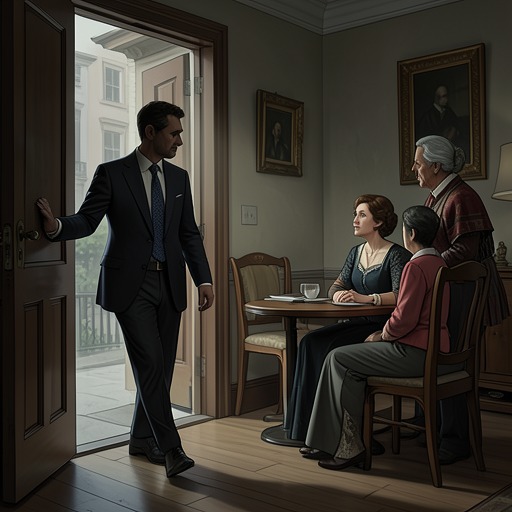
Nesibe answers the door as Kemal carries the tricycle inside. The object makes his stated purpose visible, while the roses and the presence of Çetin Efendi accompany his arrival. Kemal climbs the stairs expecting to see Füsun and initially mistakes her for her sister. When she approaches, her discomfort tells him that she does not want him to embrace her. The welcome he had mentally arranged therefore fails before the tricycle can serve as the easy opening he imagined.
Kemal talks about the tricycle and childhood memories before the meal. He drinks two raki on the rocks on an empty stomach, hoping the alcohol will take effect, but remains clear enough to recognize the limits imposed by Füsun’s marriage. He had hoped that the object might call forth a warm, brotherly feeling between them; instead, he cannot use that feeling to bridge the distance. At dinner he tries to present himself as a wealthy, well-meaning cousin visiting a poorer relation, while Füsun sits across from him and avoids meeting his eyes.
The tricycle’s history becomes more painful as the family discusses Feridun. Kemal learns that Feridun is twenty-two, lives with his wife’s family, and writes screenplays and poetry; he also learns that Feridun rode the tricycle as a child. The revelation unsettles him because it turns a familiar object into a reminder of Feridun’s established place in Füsun’s life. The tricycle has brought Kemal into the house, but its associations do not restore his former closeness to her.
Narrative Significance
The tricycle’s role changes with the stages of the visit. In Kemal’s letter and on the rainy journey, it is an errand and a pretext: returning it allows him to approach the family and imagine a future proposal. At the house, it briefly offers a subject for conversation and the possibility of shared childhood recollection. Once Kemal learns that Feridun also rode it, however, the object exposes a history of Füsun’s own, one that includes her husband and does not revolve around Kemal.
That reversal gives the tricycle its force in the episode. It cannot speak for Kemal’s desired future or make his arrival an uncomplicated reunion. Instead, it brings together childhood, marriage, and the present visit in a single material object. Kemal can carry it across the threshold, but he cannot control what memories it calls up or make those memories confirm the story of reconciliation he has prepared.